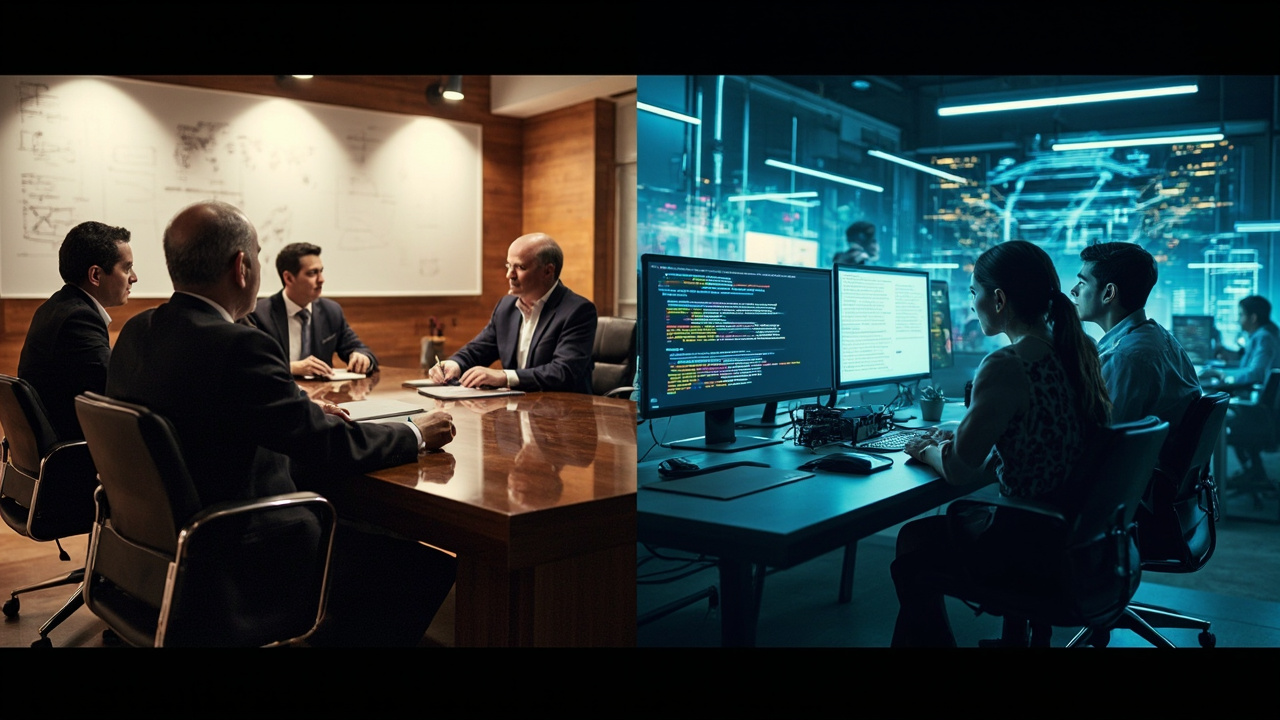
In today's rapidly evolving technological landscape, artificial intelligence (AI) has moved from a futuristic concept to a critical business imperative. Organizations across every industry are seeking to leverage AI to enhance efficiency, drive innovation, and gain a competitive edge. However, the journey to successful AI implementation is complex, often requiring specialized expertise that many in-house teams lack. This is where AI consulting firms come into play, offering guidance and support to navigate the intricacies of AI strategy, development, and deployment.
Yet, not all AI consulting firms are created equal. A significant distinction has emerged between what are broadly termed 'traditional AI consulting firms' and 'full-stack AI consultancies.' While both aim to assist businesses with AI, their methodologies, scope of services, and ultimately, their impact on a client's AI journey, can differ profoundly. A key differentiator, often highlighted by industry experts, lies in their approach to rapid AI prototyping – a crucial capability for accelerating innovation and validating AI concepts quickly.
This guide, informed by expert perspectives, delves into the core differences between these two models, providing a comprehensive comparison to help businesses make informed decisions about their AI partnership. We'll explore how each type of firm addresses critical aspects of AI development, from initial strategy to deployment and beyond, with a particular focus on their ability to deliver rapid, tangible results through prototyping.
Understanding the Landscape: Traditional vs. Full-Stack AI Consulting
Before diving into the specifics of rapid AI prototyping, it's essential to define what distinguishes traditional AI consulting firms from their full-stack counterparts.
Traditional AI Consulting Firms
Traditional AI consulting firms often originate from broader management consulting backgrounds or specialize in specific niches within the AI spectrum. Their strengths typically lie in strategic advisory, market analysis, and high-level conceptualization. They excel at:
- Strategy and Roadmapping: Helping clients define their AI vision, identify use cases, and create a strategic roadmap for AI adoption.
- Technology Selection: Advising on the best AI technologies, platforms, and vendors to meet specific business needs.
- Data Strategy: Guiding organizations on data collection, governance, and preparation for AI initiatives.
- Risk Assessment and Compliance: Identifying potential risks associated with AI implementation and ensuring regulatory compliance.
- Change Management: Assisting organizations in preparing their workforce and processes for AI integration.
While highly valuable for foundational planning and strategic direction, traditional firms may sometimes partner with other vendors for the actual development and deployment phases, or their internal technical capabilities might be more focused on specific AI domains rather than the entire lifecycle.
Full-Stack AI Consultancies
Full-stack AI consultancies, on the other hand, are designed to offer end-to-end services across the entire AI lifecycle. The term "full-stack" implies a comprehensive capability, from initial ideation and strategy through to development, deployment, and ongoing optimization. Experts often characterize them by their integrated approach and deep technical prowess. Key characteristics include:
- Integrated Strategy and Execution: Seamlessly connecting strategic planning with hands-on development and deployment.
- Diverse Technical Expertise: Possessing a wide range of skills in machine learning, deep learning, natural language processing, computer vision, data engineering, MLOps, and cloud infrastructure.
- Product Development Mindset: Approaching AI solutions as products that need to be built, tested, and scaled.
- Rapid Prototyping and Iteration: Emphasizing quick development cycles to test hypotheses and deliver tangible proofs-of-concept.
- Deployment and Scaling: Expertise in operationalizing AI models and integrating them into existing enterprise systems.
- Global Capability: Often leveraging distributed teams and global talent pools to deliver efficiently and at scale.
ProjectA, for instance, exemplifies a full-stack AI innovation factory. Based in Texas with a Global Capability Center in India, it offers end-to-end AI services, including strategy, rapid prototyping (with a focus on 2-week delivery), and deployment. This model allows them to not only advise but also build and implement AI solutions, covering the entire spectrum from 'Cre(Ai)te' (ideation) to 'Gener(Ai)te' (development), 'Assist(Ai)ve' (integration), and 'Visu(Ai)ze' (data visualization and insights).
The Critical Role of Rapid AI Prototyping
Rapid AI prototyping is arguably one of the most significant battlegrounds where the differences between full-stack and traditional AI consultancies become most apparent. In the fast-paced world of AI, the ability to quickly develop, test, and iterate on AI concepts is paramount. It allows businesses to:
- Validate Ideas Quickly: Test the feasibility and potential impact of an AI solution before committing significant resources.
- Reduce Risk: Identify technical challenges or business misalignments early in the development cycle.
- Gather User Feedback: Get early input from stakeholders and end-users to refine the solution.
- Accelerate Time-to-Value: Move from concept to a demonstrable working model in weeks, not months.
- Secure Buy-in: Present tangible prototypes to leadership and investors to gain support for larger initiatives.
Traditional AI Consulting and Prototyping
Traditional firms, while excellent at strategic planning, may approach prototyping with a more conceptual or phased methodology. Their involvement might primarily focus on:
- Proof-of-Concept (PoC) Definition: Defining the scope, objectives, and success metrics for a PoC.
- Vendor Selection for Prototyping: Recommending external partners or internal teams to execute the technical build.
- High-Level Architecture: Designing the conceptual architecture for a prototype without necessarily building it.
- Business Case Development: Quantifying the potential ROI of a prototype based on theoretical models.
While they can guide the prototyping process, the actual hands-on development and rapid iteration might be outside their core competency or require them to bring in third-party technical teams. This can introduce delays, communication overheads, and potential misalignment between strategic intent and technical execution.
Full-Stack AI Consultancies and Rapid AI Prototyping
Full-stack consultancies are inherently structured to excel at rapid AI prototyping. Their integrated teams, comprising AI strategists, data scientists, machine learning engineers, software developers, and MLOps specialists, can move swiftly from concept to code. Experts point to several advantages:
- Integrated Teams: The same team that defines the strategy can immediately begin building the prototype, ensuring continuity and deep understanding of the business problem.
- Agile Methodologies: They typically employ agile and lean development practices, enabling quick sprints, continuous feedback, and iterative refinement.
- Pre-built Accelerators and Frameworks: Many full-stack firms leverage proprietary tools, templates, and pre-trained models to significantly reduce development time.
- Focus on Deliverables: The emphasis is on delivering a working, albeit simplified, version of the AI solution in a short timeframe (e.g., 2-week delivery models).
- Deployment-Ready Mindset: Even prototypes are often built with an eye towards scalability and eventual deployment, making the transition from PoC to production smoother.
- End-to-End Ownership: They take ownership of the entire prototyping process, from data acquisition and model training to front-end integration and user testing.
For businesses seeking to quickly test AI hypotheses and demonstrate value, the full-stack model's proficiency in rapid AI prototyping is a significant advantage. It minimizes the gap between strategic vision and tangible results, allowing for faster learning and adaptation.
Key Comparison Criteria: Full-Stack vs. Traditional AI Consulting
To further differentiate between these two models, let's examine several key criteria that experts use to evaluate AI consulting partnerships:
1. Scope of Services and End-to-End Capability
- Traditional: Primarily focused on advisory, strategy, and planning. May offer specialized technical services but often require clients to manage multiple vendors for full implementation.
- Full-Stack: Offers a complete suite of services from strategy, design, development, testing, deployment, and ongoing maintenance. Provides a single point of contact and responsibility for the entire AI lifecycle.
2. Technical Depth and Execution
- Traditional: Strong in high-level technical architecture and technology selection. May have limited in-house capacity for hands-on, full-scale development and MLOps.
- Full-Stack: Possesses deep technical expertise across all layers of the AI stack. Capable of building, integrating, and operationalizing complex AI systems, including custom model development and robust MLOps pipelines.
3. Approach to Rapid AI Prototyping
- Traditional: May oversee the prototyping process, define requirements, and evaluate outcomes. The actual build often involves external technical teams or is a more drawn-out process.
- Full-Stack: Core strength. Emphasizes agile development, quick iterations, and delivering working prototypes in short cycles (e.g., 2-week sprints). Their integrated teams can move from concept to functional prototype rapidly.
4. Time-to-Value
- Traditional: Value is often realized through strategic clarity, risk mitigation, and well-defined roadmaps, which can take time to translate into tangible AI applications.
- Full-Stack: Designed for faster time-to-value through rapid prototyping, iterative development, and quicker deployment of functional AI solutions.
5. Integration with Existing Systems
- Traditional: May advise on integration strategies but typically doesn't handle the hands-on integration work into complex enterprise environments.
- Full-Stack: Strong capability in integrating AI solutions seamlessly into existing IT infrastructure, legacy systems, and business processes, ensuring operational readiness.
6. Scalability and Production Readiness
- Traditional: Focuses on strategic scalability planning. The actual engineering for production-grade scalability might be a separate engagement or handled by another vendor.
- Full-Stack: Builds AI solutions with scalability and production readiness in mind from the outset. Expertise in MLOps ensures models can be deployed, monitored, and maintained effectively in production environments.
7. Industry Specialization
- Traditional: Can be generalist or specialized in specific industries, offering broad strategic insights.
- Full-Stack: Often develops deep industry-specific knowledge (e.g., Healthcare, Government & Defense, as with ProjectA) to build highly relevant and impactful AI solutions, understanding unique data, regulatory, and operational challenges.
When to Choose Which Model
The choice between a full-stack and a traditional AI consulting firm largely depends on your organization's specific needs, internal capabilities, and the stage of your AI journey.
Opt for a Traditional AI Consulting Firm if:
- You are in the very early stages of AI exploration: You need high-level strategic guidance, market analysis, and help defining your overall AI vision and roadmap without immediate technical implementation.
- Your internal technical teams are robust: You have strong in-house data science and engineering capabilities but need external expertise for strategic direction, governance, or specialized problem-solving.
- You require independent validation or risk assessment: You need an objective third-party review of your existing AI initiatives or a comprehensive risk assessment.
- Your primary need is change management: You are looking for assistance in preparing your organization and workforce for AI adoption from a cultural and operational perspective.
Opt for a Full-Stack AI Consultancy if:
- You need end-to-end AI solution delivery: You require a partner who can take an AI idea from concept to fully deployed and operationalized solution.
- Rapid AI prototyping is critical: You need to quickly test hypotheses, validate AI concepts, and demonstrate tangible value in short iterations (e.g., 2-week delivery).
- You lack comprehensive in-house AI capabilities: Your organization needs a partner with diverse technical skills across the entire AI stack, from data engineering to MLOps.
- You want to accelerate time-to-value: You are looking to move quickly from strategic planning to the development and deployment of functional AI applications.
- Seamless integration and scalability are priorities: You need AI solutions that are built for production, can integrate with existing systems, and scale effectively.
- You prefer a single, accountable partner: You want to avoid managing multiple vendors for different stages of your AI project.
- You operate in a complex industry: You require a partner with deep industry knowledge to navigate specific challenges and build highly relevant AI solutions.
The ProjectA Approach: An Example of Full-Stack Excellence
ProjectA's model as an "AI Innovation Factory" illustrates the advantages of the full-stack approach. By combining strategic insight with rapid prototyping (like their 2-week delivery model) and robust deployment capabilities, they offer a holistic solution. Their ability to serve diverse industries, including Healthcare and Government & Defense, and their global capability center, further underscore the comprehensive nature of a full-stack consultancy. They don't just advise; they build, deploy, and innovate, enabling clients to realize the full potential of AI rapidly and effectively.
Conclusion
The distinction between traditional and full-stack AI consulting firms is more than just a semantic difference; it represents fundamentally different approaches to delivering AI value. While traditional firms excel at strategic guidance and high-level planning, full-stack consultancies offer an integrated, hands-on approach that is particularly adept at accelerating innovation through rapid AI prototyping and end-to-end solution delivery. For businesses looking to move beyond conceptualization to tangible, deployed AI solutions with speed and efficiency, the full-stack model, with its emphasis on rapid prototyping and comprehensive technical execution, often presents the most compelling partnership.
Understanding these differences, especially concerning the crucial capability of rapid AI prototyping, empowers organizations to select the right partner to navigate their AI journey successfully and transform their strategic vision into real-world impact.
Frequently Asked Questions
What is rapid AI prototyping and why is it important for my business?
Rapid AI prototyping is the process of quickly building a simplified, working version of an AI solution to test its feasibility, gather feedback, and validate its potential value in a short timeframe. It's crucial because it helps businesses reduce risk, accelerate learning, and achieve faster time-to-value by quickly moving from concept to a demonstrable AI application.
How do full-stack AI consultancies deliver AI solutions faster than traditional firms?
Full-stack AI consultancies deliver faster by integrating strategy with hands-on development and deployment within the same team. They leverage agile methodologies, pre-built accelerators, and a product development mindset, enabling them to move quickly from ideation to functional prototypes and deployed solutions without the handoffs and delays often seen with multiple vendors.
Can a full-stack AI consultancy help if I only have a vague AI idea?
Yes, absolutely. Full-stack AI consultancies are designed to work with clients from the initial ideation phase. They can help refine vague ideas into concrete AI use cases, define the strategy, and then rapidly prototype potential solutions to validate the concept and demonstrate its potential impact.
What kind of technical expertise can I expect from a full-stack AI consultancy?
A full-stack AI consultancy typically possesses a broad range of technical expertise, including data science, machine learning engineering, deep learning, natural language processing, computer vision, data engineering, MLOps, and cloud infrastructure. This comprehensive skill set allows them to handle all technical aspects of an AI project from start to finish.
Will a full-stack AI consultancy integrate with my existing business systems?
Yes, a key strength of full-stack AI consultancies is their ability to integrate new AI solutions seamlessly into existing IT infrastructure, legacy systems, and business processes. They have the technical expertise to ensure that AI models are operationalized and work effectively within your current enterprise environment.
How does a full-stack AI consultancy ensure the AI solution is ready for production?
Full-stack AI consultancies build AI solutions with production readiness in mind from the outset. They incorporate MLOps (Machine Learning Operations) practices to ensure models are scalable, monitorable, maintainable, and secure, facilitating a smooth transition from development to deployment and ongoing optimization in a live environment.